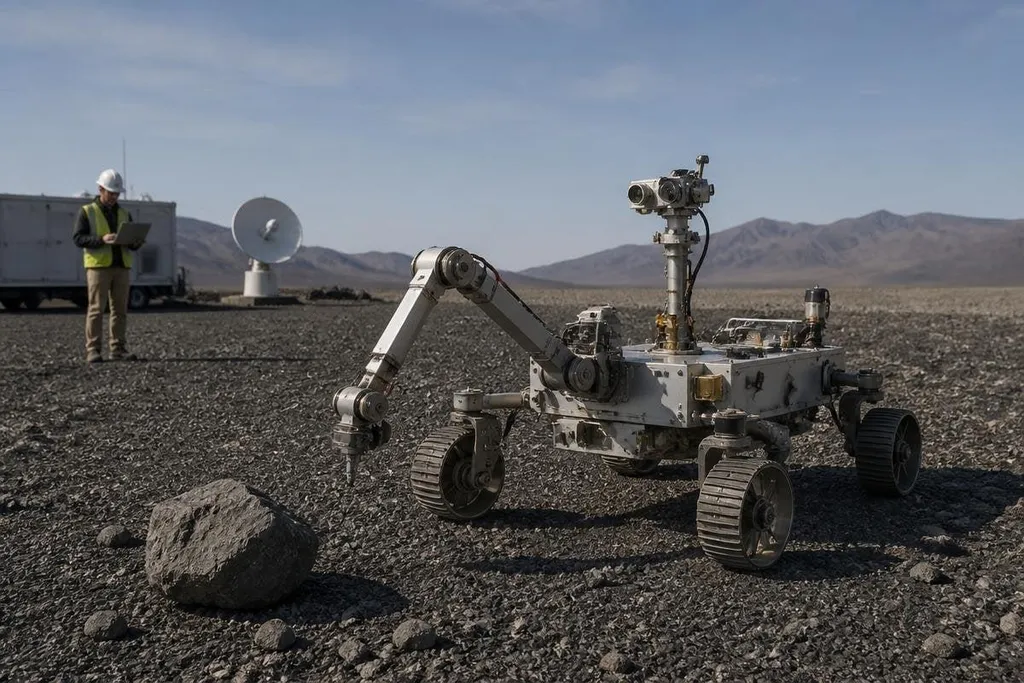
A space robot may have minutes before a command arrives from Earth, or no usable link at all during part of a task. AI helps it read sensor data, choose a safe action, and keep working without waiting for a person to approve every move.
That changes the job of mission control. People set goals and limits; the robot handles more small decisions near the work site.
- Local decisions: onboard software can sort sensor data and choose the next motion.
- Lower data load: the robot can send events or results instead of every raw image.
- Open limits: unusual ground, weak training data, radiation, and power use still matter.
Why local control matters
A command from Earth does not arrive at once. The delay depends on the distance between the spacecraft and the control team, so a robot near a distant body cannot wait for help after every wheel slip or obstacle.
An AI system can use cameras, depth sensors, force sensors, and position data to build a view of its surroundings. It can then compare that view with the task rules set by engineers.
A rover may choose a safer route around loose ground, or an arm may slow down after its force sensor detects contact.
That does not make the robot independent in the human sense. The mission team still sets the route, safety limits, target objects, and conditions that require a stop. AI handles the gaps between those instructions.
The difference matters most for work that changes from one moment to the next. A fixed script works well when the ground, lighting, and object position stay the same. Space rarely offers that neat setup.
What AI adds to the robot
The first gain comes from vision. A robot can sort rocks, shadows, dust, and hardware in an image before sending selected data to Earth. That can cut the amount of raw video that needs to cross the link, though the system still needs a way to flag uncertain results.
Planning is the next step. A planner breaks a goal into smaller actions, checks the robot's position, and selects a route that fits its limits. Engineers can place rules around that planner, such as speed limits, restricted zones, or a required stop before contact.
Learning systems can also help with movement. A robot may compare its expected wheel motion with sensor readings and adjust its control commands when the ground behaves differently. This is useful on loose soil, but a model trained in one test area may make poor choices on another surface.
That risk makes space robotics reports from Robot24.com useful. They can tie an AI claim to a named robot, test site, task, and date before the article examines the hard limits.
The hard limits remain
Space gives AI less room for mistakes. A wrong label can send a robot toward a rock, waste power, damage an arm, or end a task that cannot be repaired from Earth.
Training data is one problem. A system may learn from Earth images, test yards, and simulated terrain, yet face lighting, dust, slopes, and rocks that differ from every example it saw before. Engineers need tests that cover failure cases, not only clean runs.
Hardware adds another limit. Space robots have small power budgets, limited computing capacity, and parts that must keep working under radiation. A larger AI model may read images better, but it can also use more power and run hotter. The useful system is the one that fits the robot's energy, heat, and memory limits.
The proof standard also needs care. A short video can show a robot completing one planned action. It does not show how the system handles bad sensor data, an unseen obstacle, or a task that must stop safely. I’d trust a space robot's AI only after repeated tests cover those cases.
A practical check before deployment
A mission team judging an AI system should ask these questions before giving it control of a robot:
- What can it sense? List the cameras, depth sensors, force sensors, and position data it can use.
- What happens when data is unclear? Require a safe stop or a known fallback action.
- Which decisions stay with people? Set clear limits for movement, contact, power use, and task changes.
- How was it tested? Include new terrain, poor lighting, sensor errors, and communication loss.
- What does it cost onboard? Check processor load, memory use, heat, and battery draw.
- What evidence reaches Earth? Save enough images, logs, and sensor records to explain each major choice.
Those checks turn AI from a broad claim into a set of testable functions. They also show where a scripted system may be safer and easier to verify.
The next useful step is not giving space robots every decision. It is giving them a small set of local choices, with clear limits and enough recorded evidence to explain what happened when Earth was too far away to answer.